Academics seem to genuinely exist in a dialectically interesting relationship to emails: they really do seem to love and hate email. In the 2010s it was not unusual to see boasts about things like inbox zero, the flawed in my opinion idea that “reading” all the emails in one’s inbox is somehow a good idea and that a zero is some indication of “nothing left to do here” with respect to communicating with our colleagues, students, mentees. But also of course academics were amongst the first groups of take up email — we send loads of emails, some journals’ submission systems operate over email, mailing lists are still in use to discuss ideas, and so on.
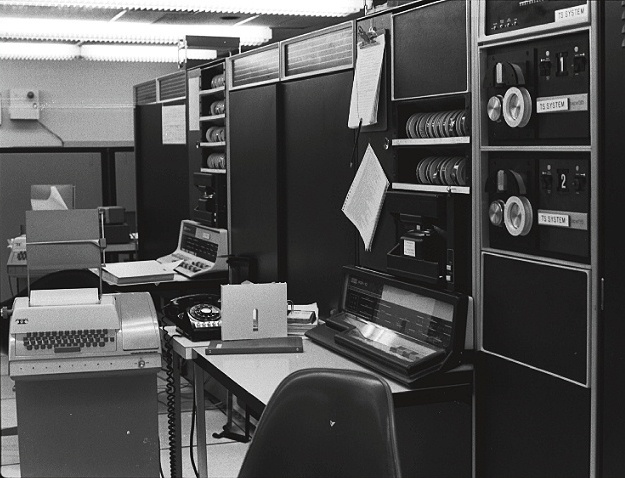 From Wikipedia’s page on the History of email: “The first electronic message was sent between these two adjacent PDP-10 computers at BBN Technologies in 1971, connected only through the ARPANET.”
I want to elaborate on two things here relating to email. First, my opinion when it comes to email is that most emails should be ignored in a deep way.Obviously, I realise this is controversial and I will explain it below! And second, also an opinion about email of course, is that replying to the emails from people that do matter to us is much more important than replying to emails from those who we do not. As with everything here, this is my perspective, may not work for you, but might be a useful point of friction or contention that could help understand yourself or your colleagues.
For the first, I really mean this, try looking at your inbox once or twice a day. Or if you only look once a day, try once a week, etc. What’s the worst that could happen? Try triaging emails when you do instead of replying immediately. Try to basically only “dedicate” your time to emailing when you can and when you want to — email only on your terms. I have basically a rule that unless an email is clear and a true one-liner to reply to and is from somebody that matters or about something that matters: I refuse to reply straight away, if not altogether. Just ignore it. There is too much email that unless it’s a colleague, student, mentee, etc., asking a question, I see no reason to reply.
I have a folder for these emails — ones on the boundary: maybe they are long, but I have decided they require a reply — called “pending”. Why? The simplest answer is: more emails lead to more emails. Adding to the general glut of emails does nothing other than to generate more emails. It causes more work for my colleagues too, not just me. So I basically try to send fewer emails, with bigger gaps between them. Relatedly, when I say a clear “no” to something that I am not directly paid to do (e.g. give a talk at their conference) and the person doesn’t take “no” for answer, then I let them take no answer for an answer. Also I try to notice when a meeting is better than email ping-pong. This is a true time-saver for me: an hour or so meeting is less effort than sending emails back and forth, communication can be easier, and my auDHD can calm down.For me, but you do you here on the same premises: save time and effort for others too but lessening email load.
On this point relating to managing our time: do not write very long emails!Unless you and the other person are known to enjoy them of course! If you can avoid it keep emails as short as possible. The more emails the more confusion — and longer emails go largely unread or undigested. I personally think if anything starts being more than two short paragraphs, you’re risking so much miscommunication if you do not switch to a meeting. Use your judgement of course, but I see no reason such long emails are well-placed for workplace communication between academics, more so when there are power differences. It’s exhausting if something that should have been an attachment or a meeting is instead in the body of a very long email. Can anybody even find emails easily anymore?
To recap, you want to be understood. Walls of text are unlikely to get you there. Papers as attachments work. Meetings as dialogue between two people also work. Long emails are more often more likely to discombobulate the other with a wall of text, or to just perform that function anyway and just go unread. But if the purpose is to communicate in a healthy way a long email is often unlikely to cut it. If a meeting is also unlikely to cut it, then the issues go much deeper than a mode of communication, but something much more substantive.
This leads us to the second related point, do always and quickly, within your boundaries, reply to those who you do care for. One of the biggest shocks going from postdoc to faculty, and especially from assistant to associate, is how nobody senior replies to emails normally anymore. This could also be cultural, or something about the 2020s that I won’t mention, but it really feels that basically nobody in any meaningful timely way replies anymore. I don’t want to be that kind of person to the people who depend on me, I care about, etc. — and regardless of if they are my direct mentees, my coauthors, etc., I feel a duty to at send some reply if needed. I think it’s much better to use a system of sorting emails (say a list of addresses in a sorting rule for important colleagues, or a sub-inbox called “pending”) that you try hard to reply to in a timely manner (maybe two times a week), than to forget completely because of the glut of emails. This being said of course patience is important too as is realising how many emails we all receive. I never expect very junior people to reply as quickly as I would expect a senior person with a secure job like me to take if we are close colleagues, purely because it’s a standard too high for, e.g. a PhD student. The most common boundary conditions are review requestsI get so many that it’s scary how even hitting “decline” is sometimes impossible. and newsletters (or similar) that I did in earnest sign up for — but then there’s the really upsetting for the state of the world emails like students looking for PhD positions that read as if they have no idea who I am, where they even get my name wrong or my university, often confusing me with a close colleague, for example.
I guess this is my mid-career email strategy. I do not care about unread emails, for example, my current unreads are over three thousand; but I do care for replying as much as possible to those who matter and in a way that lessens the burden on us all. My point in this piece is to invite us all to think a little about this. My strategies may be rubbish for you, but I think there is something to be said for us sending fewer and shorter emails.