<?xml version="1.0" encoding="utf-8"?><feed xmlns="http://www.w3.org/2005/Atom" ><generator uri="https://jekyllrb.com/" version="4.4.1">Jekyll</generator><link href="https://critical.computer/feed.xml" rel="self" type="application/atom+xml" /><link href="https://critical.computer/" rel="alternate" type="text/html" /><updated>2026-11-21T15:21:25+01:00</updated><id>https://critical.computer/feed.xml</id><title type="html">critical.computer</title><entry><title type="html">email</title><link href="https://critical.computer/email/" rel="alternate" type="text/html" title="email" /><published>2026-11-21T00:00:00+01:00</published><updated>2026-11-21T00:00:00+01:00</updated><id>https://critical.computer/email</id><content type="html" xml:base="https://critical.computer/email/"><![CDATA[<p>Academics seem to genuinely exist in a dialectically interesting relationship to emails: they really do seem to love and hate email. In the 2010s it was not unusual to see boasts about things like <em>inbox zero</em>, the flawed in my opinion idea that “reading” all the emails in one’s inbox is somehow a good idea and that a zero is some indication of “nothing left to do here” with respect to communicating with our colleagues, students, mentees. But also of course academics were amongst the first groups of take up email — we send loads of emails, some journals’ submission systems operate over email, mailing lists are still in use to discuss ideas, and so on.</p>

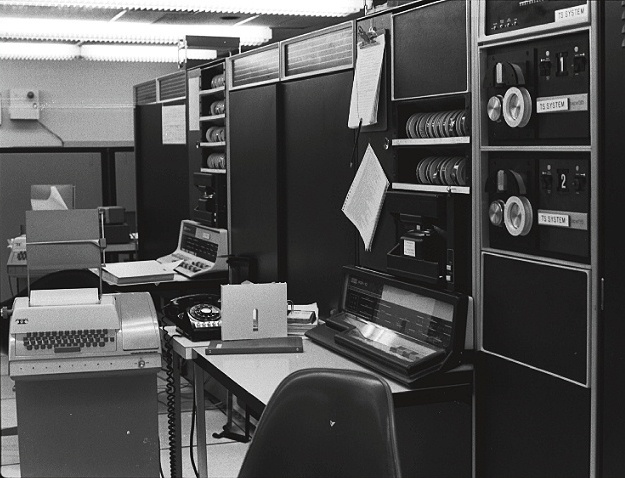
<p><img src="../img/Timesharing_and_Development_KA-10s_at_BBN,_circa_1970.jpg" alt="The first electronic message was sent between these two adjacent PDP-10 computers at BBN Technologies in 1971, connected only through the ARPANET." />
<small class="sidenote-photo">From Wikipedia’s page on the <a href="https://en.wikipedia.org/wiki/History_of_email#Email_networks">History of email</a>: “The first electronic message was sent between these two adjacent PDP-10 computers at BBN Technologies in 1971, connected only through the ARPANET.”</small></p>

<p>I want to elaborate on two things here relating to email. First, my opinion when it comes to email is that <em>most emails should be <strong>ignored</strong> in a deep way</em>.<span class="sidenote-number"><small class="sidenote">Obviously, I realise this is controversial and I will explain it below!</small></span> And second, also an opinion about email of course, is that <em><strong>replying</strong> to the emails from people that do matter to us is much more important</em> than replying to emails from those who we do not.
As with everything here, this is my perspective, may not work for you, but might be a useful point of friction or contention that could help understand yourself or your colleagues.</p>

<p>For the first, I really mean this, try looking at your inbox once or twice a day. Or if you only look once a day, try once a week, etc. What’s the worst that could happen? Try triaging emails when you do instead of replying immediately. Try to basically only “dedicate” your time to emailing when <em>you</em> can and when <em>you</em> want to — email only on your terms. I have basically a rule that unless an email is clear and a true one-liner to reply to <em>and</em> is from somebody that matters or about something that matters: I refuse to reply straight away, if not altogether. Just ignore it. There is too much email that unless it’s a colleague, student, mentee, etc., asking a question, I see no reason to reply.</p>

<p>I have a folder for these emails — ones on the boundary: maybe they are long, but I have decided they require a reply — called “pending”. Why? The simplest answer is: more emails lead to more emails. Adding to the general glut of emails does nothing other than to generate more emails. It <em>causes more work for my colleagues too</em>, not just me. So I basically try to send fewer emails, with bigger gaps between them.
Relatedly, when I say a clear “no” to something that I am not directly paid to do (e.g. give a talk at their conference) and the person doesn’t take “no” for answer, then I let them take no answer for an answer. Also I try to notice when a meeting is better than email ping-pong. This is a true time-saver for me: an hour or so meeting is less effort than sending emails back and forth, communication can be easier, and my auDHD can calm down.<span class="sidenote-number"><small class="sidenote">For me, but you do you here on the same premises: save time and effort for others too but lessening email load.</small></span></p>

<p>On this point relating to managing our time: do not write very long emails!<span class="sidenote-number"><small class="sidenote">Unless you and the other person are <em>known to enjoy them</em> of course!</small></span> If you can avoid it keep emails as short as possible. The more emails the more confusion — and longer emails go largely unread or undigested. I personally think if anything starts being more than two short paragraphs, you’re risking so much miscommunication if you do not switch to a meeting. Use your judgement of course, but I see no reason such long emails are well-placed for workplace communication between academics, more so when there are power differences. It’s exhausting if something that should have been an attachment or a meeting is instead in the body of a very long email. <em>Can anybody even find emails easily anymore?</em></p>

<p>To recap, you want to be understood. Walls of text are unlikely to get you there. Papers as attachments work. Meetings as dialogue between two people also work. Long emails are more often more likely to discombobulate the other with a wall of text, or to just perform that function anyway and just go unread.
But if the purpose is to communicate in a healthy way a long email is often unlikely to cut it.
If a meeting is also unlikely to cut it, then the issues go much deeper than a mode of communication, but something much more substantive.</p>

<p>This leads us to the second related point, do always and quickly, <strong><em>within your boundaries</em>, reply to those who you do care for</strong>.
One of the biggest shocks going from postdoc to faculty, and especially from assistant to associate, is how nobody senior replies to emails normally anymore.
This could also be cultural, or something <a href="/#about">about the 2020s that I won’t mention</a>, but it really feels that basically nobody in any meaningful timely way replies anymore.
I don’t want to be that kind of person to the people who depend on me, I care about, etc. — and regardless of if they are my direct mentees, my coauthors, etc., I feel a duty to at send some reply if needed.
I think it’s much better to use a system of sorting emails (say a list of addresses in a sorting rule  for important colleagues, or a sub-inbox called “pending”) that you try hard to reply to in a timely manner (maybe two times a week), than to forget completely because of the glut of emails.
This being said of course patience is important too as is realising how many emails we all receive.
I never expect very junior people to reply as quickly as I would expect a senior person with a secure job like me to  take if we are close colleagues, purely because it’s a standard too high for, e.g. a PhD student.
The most common boundary conditions are review requests<span class="sidenote-number"><small class="sidenote">I get so many that it’s scary how even hitting “decline” is sometimes impossible.</small></span> and newsletters (or similar) that I did in earnest sign up for — but then there’s the really upsetting for the state of the world emails like students looking for PhD positions that read as if they have no idea who I am, where they even get my name wrong or my university, often confusing me with a close colleague, for example.</p>

<p>I guess this is my mid-career email strategy. I do not care about unread emails, for example, my current unreads are over three thousand; but I do care for replying as much as possible to those who matter and in a way that lessens the burden on us all.
My point  in this piece is to invite us all to think a little about this. My strategies may be rubbish for you, but I think there is something to be said for us <strong>sending fewer <em>and</em> shorter emails</strong>.</p>]]></content><author><name></name></author><summary type="html"><![CDATA[Academics seem to genuinely exist in a dialectically interesting relationship to emails: they really do seem to love and hate email. In the 2010s it was not unusual to see boasts about things like inbox zero, the flawed in my opinion idea that “reading” all the emails in one’s inbox is somehow a good idea and that a zero is some indication of “nothing left to do here” with respect to communicating with our colleagues, students, mentees. But also of course academics were amongst the first groups of take up email — we send loads of emails, some journals’ submission systems operate over email, mailing lists are still in use to discuss ideas, and so on.]]></summary></entry><entry><title type="html">writing</title><link href="https://critical.computer/writing/" rel="alternate" type="text/html" title="writing" /><published>2026-10-31T00:00:00+01:00</published><updated>2026-10-31T00:00:00+01:00</updated><id>https://critical.computer/writing</id><content type="html" xml:base="https://critical.computer/writing/"><![CDATA[<p>When it comes to writing, another huge topic and huge part of our skill set like <a href="/reading">reading</a>, I feel more is said. Or at least I have read more about how academics and related scholars do it. The famous writer’s desk concept and related photos that you sometimes see floating around are what inspired me to buy (and even extend) my large desk, buy more than one keyboard and mouse based on trial-and-error until I found the combinations I like, and I probably will buy a new desk chair soon too. And so below, I will spell out how <em>I</em> do most of my writing.</p>

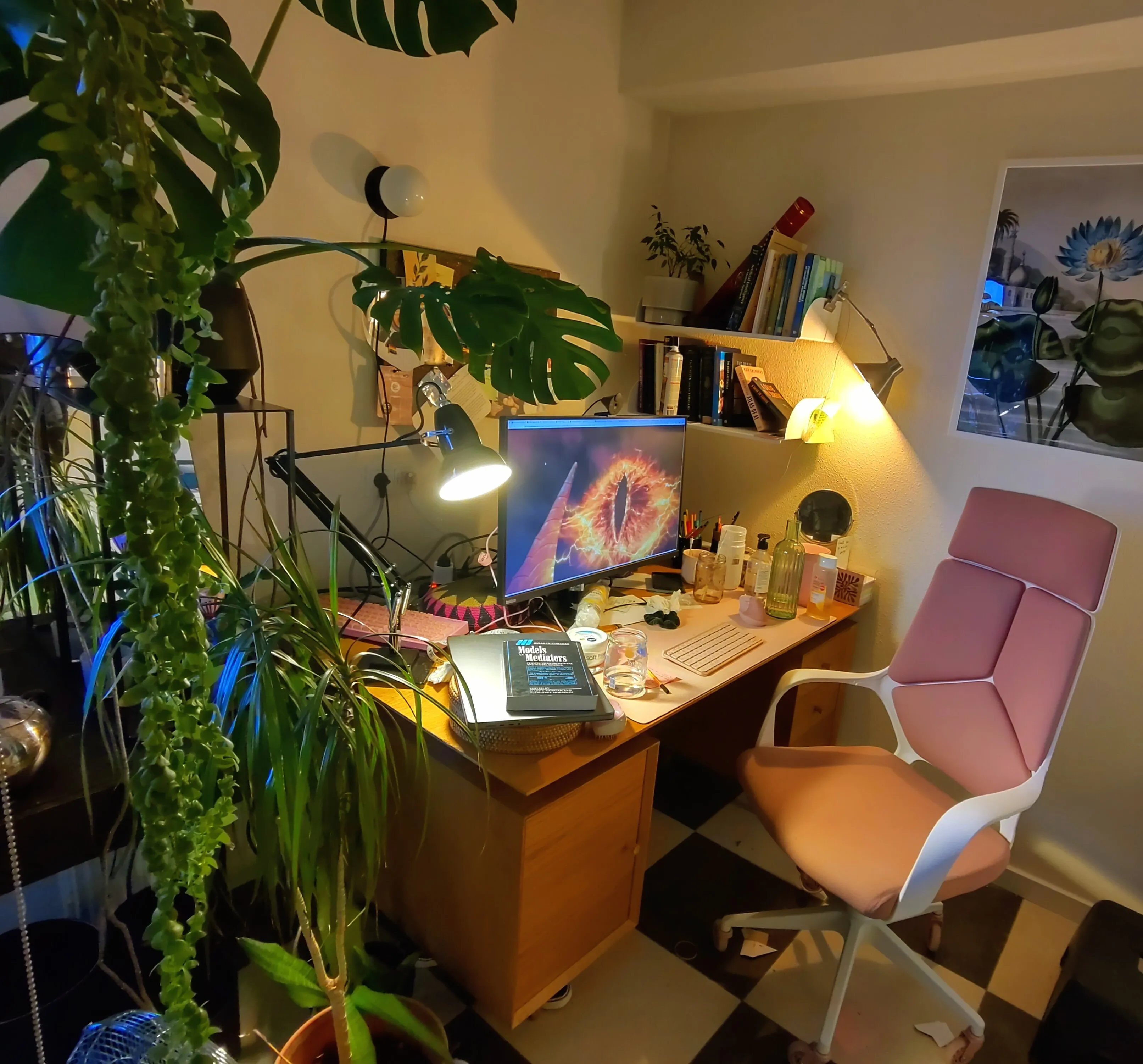
<p><img src="../img/my_office.webp" alt="My home office in all its glory on a pretty normal day in terms of mess." /><small class="sidenote-photo"><img src="../img/view_from_window.webp" alt="The view from my desk." /></small></p>

<p>One huge requirement for me is to be able to write <em>without</em> any formatting other than that provided by plain text: the ability to write paragraphs, indicate where italics and bold are, make lists, insert images, but no style per se in the area I am writing text. I need to write without distractions in the place my text is. I struggle to concentrate if I need to worry about formatting, indentation, fonts — in fact much like the writers before computers became the main tool, I prefer (need, to be honest) to type in a monospace font, in a monochrome window, with help to do references but no <a href="https://en.wikipedia.org/wiki/Graphical_user_interface">GUIs</a> or distractions.</p>

<p>I say this because, I have no idea if people realise how important this is and how damaging things like Microsoft Word are to my ability to write. I basically cannot write in Word and will freeze up; neurodivergence is just like that, I guess. In my experience this fact about my process is shocking, almost unbelievable, to some colleagues, but a plain text editor <em>is</em> more widely available, and infinitely cheaper, than Word and its clones — and in a way <a href="https://en.wikipedia.org/wiki/WYSIWYG">WYSIWYG</a> editors are ghastly if you think about it: why simulate paper on a machine that contains none? You can add that in, and so much more, later anyway, which I also enjoy doing… just not while I am trying to write!</p>

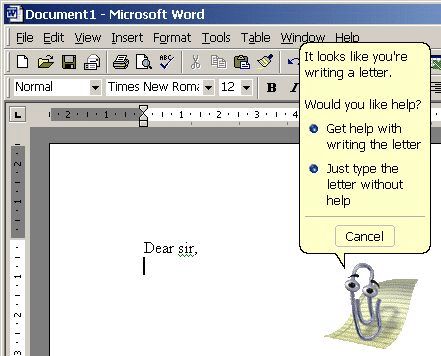
<p>Typewriters are just text. My writing is also just text. Why share this if it’s idiosyncratic? I mean, I suspect it’s not <em>that</em> unusual, but it is less said than other aspects of writing I have seen discussed, and certainly Word, and Microsoft in general, is an evil and honestly irrelevant piece of software, and a nightmarishly vile company, that we as academics especially should strive to remove from our work lives.<span class="sidenote-number"><small class="sidenote">Remember annoying stuff in <a href="https://clipart-library.com/clipart/clip-it-microsoft-word-18.htm">Word</a>?<img src="../img/clip-it-microsoft-word-18.png" alt="The image is a screenshot of a Microsoft Word document. The document is titled &quot;Document1 - Microsoft Word&quot; and has a title at the top. Below the title, there is a toolbar with various options such as File, Edit, View, Insert, Format, Tools, Table, Window, Help, and Normal." /></small></span> If you struggle, consider a free clone of Word. But if you also <em>struggle to concentrate</em>, maybe it’s useful to try just plain text like me? It’s unbelievably freeing.</p>

<p>In terms of the subjective experience of writing, I often find that writer’s block is usually complicated by the fact that I do not experience it as others seem to describe it, which like maybe things like “impostor syndrome” is a sign it’s actually nonsense. In the case of so-called impostor syndrome, it’s just a kind of gross if you think about it medicalisation of the feeling of not being accepted by a community, of even being bullied, and of the related lack of confidence one will naturally feel when they are subject to such alienation. Why call the effects on a woman from structural sexism, for example, a “syndrome” as if it’s something with a main or exclusive locus of causation and control inside the affected person? If somebody bullies you, why is there something wrong with you? Seems like there is something very wrong with the bully. Much like depression due to being ostracised is a normal (maybe even healthy to an extent) reaction, feeling “like an impostor” is the result of being excluded one way or another by external forces. Anyway call it what you like, I guess, but recognise the problem is not you — and also seek out and build, when possible, better communities. It’s hard for somebody with a PhD in Psychology to use <em>syndrome</em>, <em>psychosis</em>, etc., in such flippant ways to the people most affected though. But, I digress.</p>

<p>Writer’s block, I think — and I really can only guess — usually comes from the perhaps wrongheaded notion that when I sit down to write that I just sit and it pours out.<span class="sidenote-number"><small class="sidenote">I can <strong><em>only speak for myself</em></strong> of course. If you never had this misunderstanding, carry on!</small></span> But even <a href="https://olivia.science/anxiety"><em>if it looks like that</em></a>, that has no basis in reality: do not imagine if it looks easy and quick, that the process was easy or quick. Don’t fall into the trap of thinking that “<a href="https://olivia.science/entryism/">because things <em>look</em> a certain way, that therefore they <em>are</em> a certain way.</a>” Every event that may look like “she just picked up the keyboard and wrote six paragraphs” has been preceded by weeks, if not months and years, of thinking about, and especially <a href="../reading">reading</a> about, this issue. Years of training — and do not forget if you do not have a PhD done and dusted yet, that a UK-style monograph PhD (which I finished and continued to build my skills from fifteen years ago) is usually at least one year or 100% non-stop writing at the end — have gone into my ability to just write out what I have spent the last few months thinking about. This is the life of the academic, and you may be tasting it too if you’re just starting out your journey: good luck!</p>

<p>So that’s what it isn’t. What is then the feeling, because of course I grant it’s a blockage, of the block? It’s the lack of preparing, of knowing that the very first, zeroth even, step to write is to think and read deeply about the topic, sometimes I even draw or doodle, I bought a whiteboard, etc. If you want or need to write about something, start reading about it. Or find what it is that helps you. It’s unlikely you can just start writing about that something if you feel a block. And it’s not procrastination either. It’s the required way to start to write.</p>

<p>I will add more here, but for now here’s all that above…</p>]]></content><author><name></name></author><summary type="html"><![CDATA[When it comes to writing, another huge topic and huge part of our skill set like reading, I feel more is said. Or at least I have read more about how academics and related scholars do it. The famous writer’s desk concept and related photos that you sometimes see floating around are what inspired me to buy (and even extend) my large desk, buy more than one keyboard and mouse based on trial-and-error until I found the combinations I like, and I probably will buy a new desk chair soon too. And so below, I will spell out how I do most of my writing.]]></summary></entry><entry><title type="html">reading</title><link href="https://critical.computer/reading/" rel="alternate" type="text/html" title="reading" /><published>2026-10-12T00:00:00+02:00</published><updated>2016-10-21T00:00:00+02:00</updated><id>https://critical.computer/reading</id><content type="html" xml:base="https://critical.computer/reading/"><![CDATA[<p>There does <em>not</em> seem to often be a discussion about how to read things, how to make highlights, how to sit in silence and digest something, how to read like an expert, and maybe the holy grail how to constructively critique something and give feedback, like in formal or informal peer review. Nonetheless, it seems a very pertinent topic these days where I see (accidental or not) misreadings of the literature. Historically, of course there have also been examples of (weaponised) misunderstandings of certain people’s work.<span class="sidenote-number"><small class="sidenote">I want to talk about the nice(r) side and explain things for juniors especially, like students, but really do take “reading” here in the broadest sense, while also bearing in mind that for academics it means <em>deep engagement</em> such that one can produce feedback or even critique.</small></span></p>

<p>Anyway, not all the ways of reading I listed at the top are prerequisites to reading in a scholarly way, but I will go through some angles and perspectives on how to do this I have picked up, all the way until we get to formal peer review. Reviewing requires a certain kind of reading and decision to read that is built up over months and years and when performed well should succeed at the goal of improving our colleagues’ work.</p>

<h3 id="what-why-and-how-to-read"><a href="#what-why-and-how-to-read">what, why, and how to read?</a></h3>
<p>First, the decision on what to read is primal, obviously. Simply put, there are cases where something just does in fact need to be read. But in that case you still need to able to say why. It’s good to be a little introspective here as “because my mentor said so” might indicate either that you are not taking this seriously (which would open up other questions) or that your mentor did not explain why well enough (a good one should be open to discussing this again) or something else. If the answer here to what to read is: because <em>this paper offers something that you do <strong>not</strong> know about yet</em>, you will have to bear that in mind below. I would argue this is always true, but of course there are cases of more novel points or fewer as some papers are review articles, for example, and you may indeed know a lot of the basics.</p>

<p>Second, is the way in which to read — how to get the most out of reading, what sort of mental state to be in. Scholarly reading is not just skimming, but certainly includes skimming: we will return to the zoomed in aspect in <a href="#how-to-actually-read">how to actually read</a> below.</p>

<p>What I consider the biggest stumbling block at this stage, and it links back to accepting that the paper offers something truly new to you, is that as a reader <strong>you must trust the author</strong>. If you do not, grant it now for the sake of learning — critique involves not exactly less trust, but a different way of reading. In the case of engaging with literature outside your direct expertise or equivalently of an area that is not yet your main research area <em>extreme humility</em> needs to be at the core of your conceptualisation of what you are about to intellectually ingest. To really get the best out of the journal article, book chapter, and so on, you must commit especially to not jumping to conclusions. <em>Any utterance can be reduced immediately to the absurd</em>, especially if you want it to. The point here is to learn something from the author, however, not mock them or perform reductio ad absurdum (yet). The point is not to project your understanding of the world, but to understand what the author has to say. Try to take another person’s perspective.</p>

<p>And so you must understand that you are entering another world. Think of it a little like stepping into another person’s house. You cannot open random doors and expect the kitchen to be where yours is. By the same token of course, it can be the case the general configuration is like your own home, e.g. it’s possible the conclusions are all at the end, that there’s an abstract up top, that section headings are appropriately descriptive, etc. This concept of granting that the author has <em>something</em> to teach you is really so important and it is something that I see most often violated in cases where somebody has utterly failed to grasp a piece of writing. If you struggle to do this and only want to hate-read, take everything as if it is nonsense, then bear in mind this is unlikely to lead to a scholarly understanding of the other except in extremely unusual cases.</p>

<p>This bears repeating: if you decide to read something only to disagree, you will likely learn less than if you go in with a more charitable perspective.
Or to put it the other way round, if you only or mostly read repulsive and awful pieces that deserve to be hate-read, that definitionally sounds like a bad time and you should mix things up.
And importantly superficial disagreeing or misreading and critique are not the same thing — in fact you must deeply understand the other person’s writing to critique them.</p>

<h3 id="time-management"><a href="#time-management">time management</a></h3>

<p>At this juncture, you must be ready to decide how long you can dedicate to this piece of writing. So let’s assume it’s fixed in place you want or need to read it: we now need to negotiate how long you can spend on it. For sure skimming something that needs to be read is better than not touching it at all. We have to get this out of the way: <em>do you have time to properly read most of this article?</em></p>

<p>To help you help yourself, I am going to answer from three very different perspectives: PhD student, faculty, layperson. Each of these are stereotyped as having distinct, although not mutually exclusive goals.<span class="sidenote-number"><small class="sidenote">Feel free to place yourself in any or all these groups. I use them merely as shorthand. Nobody is in only one and <em><strong>everybody</strong> is a layperson</em> to most expertise, even — especially! — other experts.</small></span></p>

<p>The <strong>PhD student</strong>,<span class="sidenote-number"><small class="sidenote">I don’t want to get into this here, but I have not used “candidate” for a number of (principled) reasons. For what it’s worth, I think students are amazing and the <em>very reason</em> we as faculty go to work.</small></span> reminding myself of my own journey and of my own mentees, wants to both understand things very deeply, has a lot of time (at least compared to the other two), and has an explicit mentor (in the best case) or just a supervisor (less ideally). They want something very personal to learn a great deal about something because they are passionate about researching it, because they are on their journey to becoming a true expert in a niche area, and because they deeply want to be aware of what their (sub-sub-)area of research is doing in the current year, the past, and where it might be going. The <strong>faculty member</strong> has a lot of reading to do, sometimes only possible at a fast pace, some for peer review, some for admin or committees, some for feedback or marking of essays for mentees or students, and so on. Their main priority is often giving an expert opinion, constructive feedback, or making sure they are aware of what others in their field(s) are saying these days. The <strong>layperson</strong> actually is the only one who is choosing (under my stereotypes) to read this specific piece of academic writing purely for fun, curiosity, or to understand something deeply for no particular reason other than personal gratification or edification. In my silly and simple stereotypes, they are not trying to become an expert.</p>

<h4 id="phd-student"><a href="#phd-student">phd student</a></h4>

<p>I’ll start with the PhD student’s possible decision-making process for time management. And I’ll speak from authority in the sense that I have been there, so I know for a fact there are no ways out of certain things, like rereading the same paper upwards of a dozen times.
In this case, you have to triage your reading. Some books and papers will be read countless times, and it’s a good use of time to accept that in a weird way.
I think there was a paper or two during my PhD I printed out and had on my desk because it was just simpler to have it there to keep reading it than to look for the PDF. Something like this may happen to you. The same may also go for a document produced by your mentor and you to help you plan your PhD (like a thesis proposal): that may be something you need to keep rereading. When doing something new I seem to be very slow compared to others because I recognise on some level that this process is important, so I feel I know less until I know I know a lot more.</p>

<p>In some way the PhD student’s situation is such that they are <em>rich on time, but poor on management</em>. If you’re a PhD student: your time will lessen as you move deeper into your academic career, so if you do not master managing it now, it sadly only gets worse. Therefore, this may be a nice opportunity to really practice the latter skill of management where failures are less important as you have more time to play with. Another aspect is to find ways to read as quickly as possible not because you have to, but because again this will come in handy later in your career. One good tip is to practice reading as fast as you can scroll your mouse in a leisurely way, and then compare what you gleaned with respect to a proper slow read through. Again this could be immensely useful later on if you want to work in academia.</p>

<p>Notwithstanding, the main skill relevant to this stage is knowing <em>why you are reading what you are reading</em>, what it is giving you (if anything), and if it is a good paper. Often a mantra you hear is “this is such a tough paper to understand, it must be good!” Is this really though what a good paper should be like? Another thing that could be of value to notice at this point is are papers formulaic: for an author, for a group, for a sub-field? Who is <a href="https://en.wikipedia.org/wiki/Least_publishable_unit">salami slicing</a>? Who is writing papers that should have been split into smaller units for comprehension and readability? Who is publishing horizon expanding work? Do all authors write good abstracts? When is an abstract representative?<span class="sidenote-number"><small class="sidenote">This can be checked by reading the abstract first before the paper and then comparing what you thought before and after. Make a note if it helps to keep track as your preconceptions and first impressions may get intermingled with your conclusions after reading.</small></span> These questions get easier and easier to answer the more papers you read, and the PhD is the right time to read as much as possible.</p>

<p>So to summarise, to the PhD student, I say this: take your time, allow yourself to “waste” time reading the (same) paper many times, prepare yourself for how this seemingly repetitive task will actually be different every time you reread. Yes, managing time at this stage is allowing yourself to spend a lot of time on reading.</p>

<h4 id="faculty"><a href="#faculty">faculty</a></h4>
<p>Now for the faculty member’s time management, who in this <em>stereotyped</em> view has tenure or a permanent contract.<span class="sidenote-number"><small class="sidenote">I would assume postdoc can be a mix of this and <a href="#phd-student">PhD student</a>, but I trust you all to use your judgements. Nothing here is a real-life situation, you need to translate these simple roles for your reading activities as needed.</small></span> As faculty, we have the most combined duty and control towards and over our reading. There are articles we are absolutely obliged to read in their entirety: we are directly or indirectly paid to read some texts through our salary, and the proper and close reading of which forms part of the core of our duties towards our profession.</p>

<p>I’ll paraphrase what I said above: We have a lot of reading to do, <em>sometimes only possible at a fast pace</em>, some for peer review, some for admin or committees, some for peer feedback, and some for giving grades to students, and so on.<span class="sidenote-number"><small class="sidenote">Probably some emails are of the same kind of reading — but most are not! In most cases, email and instant chat are weaponised and are damaging to academia and our needs.</small></span> Importantly, either as a proximal or distal goal: we read to maintain and enhance our expertise. For example, we want to know, as part of our craft and skillset, what others in our field(s) are pushing out into the literature.</p>

<p>And so for the faculty member, the question <em>“do you have time to properly read most of this article?”</em> is a workplace duty to be able to answer effectively, and when the answer is “yes” to do so at the appropriate depth and quality. The last thing you would want is to think you understood, i.e. think you’ve deeply read something, when you haven’t. In fact that could even constitute a scary dereliction of duty, say in the case of being on a committee that has to produce university policy documents. It could be professionally reckless, such as in the case of giving expert opinions on, e.g. a book or journal article. But minimally such a misconception could be a potential source of (mild to severe as a function of context) embarrassment — if one thinks one deeply understood and reasons from there. So if you decide to skim, you must remember that’s <strong>all</strong> you did.</p>

<p>I will triage the <strong>time management</strong> here without discussing a repository for saving useful articles, i.e. I assume we’re not deferring.<span class="sidenote-number"><small class="sidenote">This is for staying concise in this post and <em>not</em> because it’s not useful to do that.</small></span> OK, so let’s look at the three levels for faculty to manage their reading time for journal articles or similar — none are mutually exclusive:</p>

<p><strong>a</strong>) This is a <em>must read because I need to know what my peers, or a very related fields’ scholars, are up to</em>. There is only one sensible answer, you must skim it. This does not preclude reading it in more depth once you answer the “what are they up to?” question. In fact I would argue most in-depth readings should start with a full skim anyway to help you get the lay of the land. Ideally just do it as you find  articles that you decide must be read.  <strong>Set aside 20 minutes</strong> at least.</p>

<p><strong>b</strong>) This is a <em>foundational piece of work that I suspect or know will change how I see things</em>. You might have figured this out from <strong>a</strong> above. You ideally cannot postpone this if it is vital for your discipline: this is your job. If you have no time for reading, that’s a serious problem that may not affect <em>how</em> much this is important for you to read, only that you are overloaded and cannot.<span class="sidenote-number"><small class="sidenote">For some, it is  important to underline that this is <strong><em>not</em></strong> <em>research</em> time. Universities teach at the highest possible level, so it’s also our duty as educators to be up-to-date on what the fields we teach in are up to.</small><span> <strong>Set aside a whole day</strong> at least — or if you have no time for this kind of proper reading: unionise and more.</span></span></p>

<p><strong>c</strong>) This is a <em>piece of text I have accepted to review or otherwise give peer feedback on</em>. Here you really do need to read it very carefully since accepting to review should only occur, in my opinion of course, under the understanding that it is an opportunity <em>to help others</em> improve their work. More than <strong>a</strong> and <strong>b</strong> above, this one might require note-taking, especially since your feedback will be given in writing to, e.g. the journal editor. <strong>Set aside 2–3 hours</strong> at least.<span class="sidenote-number"><small class="sidenote">If you have trouble properly reviewing — I see this with junior faculty colleagues — then consider at first dedicating a whole day. Ideally this should not take so long, but it might if you’re just starting out.</small></span></p>

<p>My final point on managing reading time here for faculty is that it is sometimes very obvious to me who does and who does not read when they talk (or even write) about topics I have read a lot about — or if they mentioned my  work as if they have read it. Most confusions I think stem from confusing <strong>a</strong> and <strong>b</strong> above, e.g. as having the same effect on the reader or confusing a paper that should be read deeply with one that can be just skimmed.<span class="sidenote-number"><small class="sidenote">Also “I read your abstract and disagree” is honest, but still deeply disrespecful to an author’s time, for example.</small></span> There is nothing terminal about this, anybody who is a permanently employed academic can start to prioritise, or demand to be given back, this important part of our jobs.</p>

<p>The next few sections are still to be written…</p>

<h3 id="how-to-actually-read"><a href="#how-to-actually-read">how to actually read</a></h3>

<h3 id="when-and-how-to-give-feedback"><a href="#when-and-how-to-give-feedback">when and how to give feedback</a></h3>

<h3 id="concluding-points"><a href="#concluding-points">concluding points</a></h3>]]></content><author><name></name></author><summary type="html"><![CDATA[There does not seem to often be a discussion about how to read things, how to make highlights, how to sit in silence and digest something, how to read like an expert, and maybe the holy grail how to constructively critique something and give feedback, like in formal or informal peer review. Nonetheless, it seems a very pertinent topic these days where I see (accidental or not) misreadings of the literature. Historically, of course there have also been examples of (weaponised) misunderstandings of certain people’s work.I want to talk about the nice(r) side and explain things for juniors especially, like students, but really do take “reading” here in the broadest sense, while also bearing in mind that for academics it means deep engagement such that one can produce feedback or even critique.]]></summary></entry></feed>